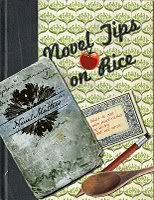
 Special Announcement! We will give away a copy of our ultra-cool Novel Tips on Rice: What To Cook When You'd Rather Be Writing cookbook to someone who comments today! And we'll mail it to you -- or to your mother -- just in time for Mother's Day. (What? You want a copy for Mother's Day? Just contact Latayne@Latayne.com and she'll mail one out to you TODAY for your PayPal payment of $12.99 plus priority mail postage!) Now back to our regularly scheduled wonderfulness by Patti.)
 Welcome to our book talk about Bird by Bird by Anne Lamott. We're talking about her chapter on plot today. Even if you haven't read it, please feel free to add to the conversation. We're all teachers here!
We aren't going to learn all we need to know about plotting from the "Plot" chapter in Anne Lamott's book, Bird by Bird. She says as much when she suggests books by E. M. Forster and John Gardner. But she reminded me of things I definitely needed to hear.
"That's what plot is: what people will up and do in spite of everything that tells them they shouldn't..."
Stories are about what people will DO to get what they WANT even if what they're willing to do is a little--or a lot--crazy. I've read some wonderful stories over the last few years, but The Help stands out for its inconspicuous yet charging plot. Every character wants something worth dying for. Talk about tension on every page. And what do the maids want? They want to tell their stories. They want a voice. They want the world to see that the babies they loved and raised hate them beyond reason. As for Skeeter, she wants purpose--a bit of irony there but completely believable. Carrying her typewriter to the colored section of town was pure foolishness, unless you want to rise above your legacy, and Skeeter did.
"I'm the designated typist, and I'm also the person whose job it is to hold the lantern while the kid does the digging. What is the kid digging for? The stuff. Details and clues and images, invention, fresh ideas, an intuitive understanding of people. I tell you, the holder of the lantern doesn't even know what the kid is digging for half the time--but she knows gold when she sees it."
Once I know my character very well and have a handle on what she wants (this will change many times), that's the time to lean in with the lantern. For me, this isn't sit-in-the-chair work. It's my hands-are-wet-and-I-don't-have-a-thing-to-write-with work. I daydream freely about my character--what she will do when she sees her world tilting and spinning away, how she will show the reader where her passion resides, and what she will do when she is pressed to the wall with a knife to her throat, metaphorically speaking.
The smart thing to do is dry my hands and write it all down--or the dreams evaporate, not that the dream stuff is always used, but it's all foundational, very important stuff to know about the character and how she moves through her story world.
"The climax is that major event, usually toward the end, that brings all the tunes you have been playing so far into one major chord, after which at least on of your people is profoundly changed. If someone isn't changed, then what is the point of your story."
While home sick from work a couple weeks ago, I watched lots and lots of movies. (I don't sleep well when I can't breathe.) Since we don't subscribe to premium channels, I did some pay-per-view selections from our cable company. I watched Black Swan and right after that, Country Strong. SPOILER ALERT: I'm going to talk about the endings of these pictures. In Black Swan, Nina, the ballerina who must play the dual parts of the white and black swan in Swan Lake, struggles to express the wildness, the wantonness of the black swan. As a psychological thriller, it's not always easy to know what is reality and what is mindscape, but Nina dances the opposing parts with perfection on opening night. And then she dies, probably by her own hand. In Country Strong, an alcoholic country star is prematurely taken out of rehab for a comeback tour through Texas. She botches her first performance, misses her second, but nails the third in Dallas, even though she is back on pills and booze. After her stellar performance, she locks herself in her dressing room and overdoses.
The endings/climaxes left me cold. The characters fight for change but find the change unsustainable, and so they destroy themselves. Perhaps the changes were unsustainable, but an option would be to redirect the protagonists' desires. That would have worked better in these movies, but I'm a hopeful person. Dead is a big change for a protag, but not a very satisfying one. Keep that in mind when writing your climax. I do not want to revisit the pessimism of the 60s and 70s again. Please!
Let's talk! What was the last book you read that had you sitting on the edge of your chair, saying, "Don't go in there," but you loved the story and couldn't stop reading? What does holding the lantern look like for you? Do you have your climax in mind when you start a story? Have you ever been surprised by your climax? What struggles do you have with plot? What resources have helped you?
We'll be talking about dialogue on May 18th.