Showing posts with label Elmore Leonard. Show all posts

Wednesday, October 23, 2013

Where do I begin??

Patti began our Roundtable discussion on Monday talking about what to cut from your novel, particularly at the beginning of a piece. In the Comments section it was asked, how do you know where a story truly begins? And is there a rule about when backstory comes in?

Well, let's see what the pros have to say in reply.

Sol Stein in Stein on Writing (pg. 15), says:

Elia Kazan, brilliant director of stage and screen as well as a late-blooming novelist, told me that audiences give a film seven minutes. If the viewer is not intrigued by character or incident within that time, the film and its viewer are at odds. The viewer came for an experience. The film is disappointing him.
Today's impatient readers give a novelist fewer than seven minutes. Some years ago I was involved in an informal study of the behavior of lunch-hour browsers in mid-Manhattan bookstores. In the fiction section, the most common pattern was for the browser to read the front flap of the book's jacket and then go to page one. No browser went beyond page three before either taking the book to the cashier or putting the book down and picking up another to sample ... first sentences and first paragraphs ... are increasingly important for arousing the restless reader.

I can attest to the truth of the study. If page one of a novel doesn't engage me, I move on. My reading time is precious to me. I don't have time to waste or wade through a slow beginning.

Elizabeth George in Write Away (pg. 65), which is one of my personal favorites, wrote in her journal:

...I'm beginning to have more clarity on the novel. What I haven't seen yet is precisely how or where in the story to begin.

Then, regarding the decision of where to open, she goes on to say:

The way I see it, you have three alternatives. You can begin the story just before the beginning; you can begin it right at the beginning; or you can begin it after the beginning.


Huh?

Well, she actually makes sense as she continues:

Starting just before the beginning, you ... have to come up with a scene that illustrates the status quo of the main characters before the primary event occurs.
If you choose to start your novel right at the beginning, you are making the choice to introduce simultaneously both the characters and the primary event that gets the ball rolling ...
Beginning your novel after the beginning of the story means that you are choosing to start after the primary event has occurred. The ball, in other words, is already in motion and the reader is plunked down in the middle of the action.

James Scott Bell in Plot & Structure (pg. 56), cuts right to the chase and gives us a nice check list:

  • Get the reader hooked.
  • Establish a bond between the reader and the Lead character.
  • Present the story world---tell us something about the setting, the time, and the immediate context.
  • Establish the general tone of the novel.
  • Compel the reader to move on to the middle. Just why should the reader care to continue?
  • Introduce the opposition.
This is all great advice, and by examining our beginnings we can see if we're hitting any of these targets, but it can still be difficult to know if we've hit on the right place to start. Elmore Leonard, who wrote among other things Get Shorty and 3:10 to Yuma, once said, "I try to leave out the parts that people skip." Yeah, me too. That's especially important when it comes to those opening paragraphs and pages, because, like Sol Stein discovered, if a reader isn't engaged by then, he's not going to be.

As an exercise, turn to the beginnings of half a dozen of your favorite novels and study the openings. What was it about those first few paragraphs that kept you reading? Conversely, was there something that nearly derailed you---even if you're glad you kept reading? Judging by the advice of our pros, did those beginnings line up with the advice they gave?

I'll give an example from one of my favorite novels, Blue Hole Back Home, by Joy Jordan Lake. First of all, it was the cover that got me to pick up the book, which was a title I'd never heard of, by an author I'd never heard of. But the cover intrigued me, so I opened to the first page and read:

Likely it was only two dreams crisscrossing paths, one snagging on the other in passing, but somehow the face that walked by me this morning, not four feet away, got tangled up with one from my past ... And I swear time backstitched on itself ...

I loved that last line, loved how it sounded, loved the picture it drew in my mind. But this is what took me straight to the cashier:

In that moment, the smell of espresso got overpowered by the scents of my past: pine needles and boy-sweat, salted peanuts and Coke. I heard bluegrass guitar and banjo all mixed up with rhythm and blues and a rope swing ticking forward and back, keeping time. I was barefoot in the back of a pickup, believing that it was love that makes people brave and gorgeous and clever and kind. Believing, and being wrong.

Man, oh man, that was the line that hooked me. I've read the book several times and recommend it to anyone who will listen, and I grow fonder of it each time.

Besides Blue Hole Back Home, I highly recommend the three books I cited today. I've read each of them more than once, and I learn something new every single time. Write Away has so many notes and sticky tabs it's getting difficult to wade through. It may be time for another copy.

I'd like to hear your observations on the passages I cited. We'll talk about backstory when I post in a couple of weeks.


Wednesday, October 5, 2011

Would you explain that, please?


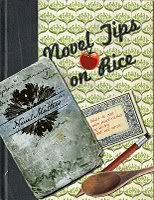
It's October, and the holidays are just around the corner! A bound version of Novel Tips on Rice might be just the thing for that gift exchange at work, or for that hard-to-buy-for friend. It's not only filled with some of our favorite recipes, but there are quotable quotes from the 6 of us, and the graphics in this little book are amazing. Consider giving yourself one as well. Contact us for more information.


Let me say first that in California it's soda. Not pop. Not coke (generically speaking). And never, ever soda pop. Just soda.

I thought it was interesting that Debbie's post came immediately after Bonnie finished reading/editing on of my manuscripts. Bonnie. From Canada. I was amazed to discover the differences that exist in language between my small place in the world, and hers, even though our countries are next-door neighbors on this planet. At times I laughed at the references she didn't understand or wasn't familiar with; other times I was just plain surprised. For example: I laughed when she questioned my use of the phrase "crazy bone" instead of "funny bone." She'd never heard "crazy bone" before. So I wondered, is this just a family thing for me, that I use crazy bone instead of funny bone because that's what I grew up hearing? But I checked the dictionary and sure enough they're interchangeable. And when I made reference to AARP, Bonnie said, "I don't know what this is, but I'm Canadian ..." That really made me laugh.

I also had to laugh at Henrietta's "knock me up" comment. She'd have gotten a double-take from me, for sure. It reminded me that in America when we say, "I'm stuffed," we mean that we're full from a hearty meal. But in South Africa, it's a crude sexual term. Who knew?

Bonnie's comments to my manuscript combined with Debbie's post were reminders that how we present our message matters. It's important that we not lose our readers with our jargon. Sure, there are times when jargon adds to the characterization of a cast member of your novel. And usually the reader can discern the meaning of unfamiliar words/terms by the context in which it's used. But since the purpose of writing is to communicate, it behooves the writer to keep jargon to a minimum. This is one area where an editor can help point out language that might be too narrow in its scope.

Another way to lose or frustrate readers is to pepper your prose with words most people don't know the meaning of. I enjoy coming across a new word every now and then as I read fiction, but who wants to read for pleasure with a novel in one hand and a dictionary in the other? I realize most e-readers will define any word the cursor stops on. But having to use that feature repeatedly would certainly take the pleasure out of reading. And if, like me, you prefer to hold a real book in your hands when you read, you either look up the words you don't know or skip over them.

Which leads me to my main point. As Christian authors we continually run the risk of speaking a language not everyone understands. Even within Christian circles terms can mean different things to different denominations. To those unfamiliar with Christianese we might as well be speaking Greek. It's a sure way of alienating a reader. We who write faith-based fiction should strive to write it as though we're speaking to people who don't understand the language of the church.

I love the quote by by author Elmore Leonard, who said of his writing: "I try to leave out the parts that people skip." I'm one of those readers who never skips a word. Not one. I don't skim over description, and if I come to a word I don't know the definition of I look it up. I'm pretty sure I'm in the minority in that regard. What about you? What kind of reader are you?

Friday, May 27, 2011

"He Says ... or Does He?"

As Katy points out in Wednesday's post, Elizabeth George and Elmore Leonard -- and many other experts on the writing craft -- opine that "said" is the best choice when seeking a dialogue tag, for the very reason that it doesn't compete with or interfere with the flow of the dialogue. And I concur. Does that mean I -- or they -- believe a writer MUST ONLY use the word "said" in writing dialogue? Absolutely not. Nicole, in her comment to Katy's post, said, "You know, "said" is boring. Repeatedly "said" is annoying." I agree. The point is not to ply the page with one "said" after another. It's to find a way to make your dialogue sing, to stand out from the masses, by writing dialogue that needs minimal attribution, and by employing action tags that don't simply replace dialogue tags for the sake of replacing dialogue tags, but that add to the story and character development.

Another writing book I'm partial to is Shut Up! He Explained by William Noble. Is that the best title ever, or what? In Chapter 8, He Says ... or Does He? Noble writes that Harold Ross, unpredictable and somewhat zany editor of The New Yorker, developed editorial rules for manuscripts. Noble writes (forgive the lengthy passage):
One of the rules ... was that a passage of dialogue is best followed by "said." Anything else --"shouts" or "exclaims" or "retorts," for example -- is just wasted motion. No verb, in other words, should substitute for "said." It got me thinking ... "Stuff it in your ear!" he ... said? Wouldn't "retort" be better? ... I thought further ... A writer should be able to phrase dialogue so the impact of the words would be clear. "Go to [hades]!" he shouted -- could be redundancy. "Go to [hades]!" itself is a strongly worded statement, and why do we need "he shouted"? Of course, maybe we don't need any modifying phrase at all. "Go to [hades]!" could stand by itself. No "shout," no "said," no nothing. The reader's imagination could probably conjure a fitting modifier.

Today, even The New Yorker allows substitutions for "said." Yet the rule shouldn't be dismissed because [it] ... had considerable merit. A writer should be able to create dialogue that doesn't rely on the descriptive modifier; the words a character speaks should carry the emotion in which the words are spoken:

"You-you aren't my dead uncle's long-lost great-great grandson!"

"Oh Everett, I love these children so ..."

In the first sentence do we need modifiers like he gasped, or he blurted out ...? Wouldn't he said work as well? Perhaps we don't need to say anything -- maybe that would work even better.

In the second sentence, do we need she purred, she whispered --? We could insert she said, and it wouldn't detract from the impact of the dialogue. Then, too, perhaps nothing at all would be even better.

There are no precise rules on when to use "he said," when to use a substitute, and when to use nothing ... Generally, however, we can say this:

"he/she said" is the basic modifier, and it should be used at least three-quarters of the time any modifier is used."
That is my belief, and the principle by which I write dialogue. I believe those 1% of writers that Katy mentioned in her post -- that 1% that outshines the average writer -- are not the ones that find a variety of substitutes for the word "said," but rather they are the ones who write dialogue so expertly that attributes are not simply unnecessary, they get in the way. Consider this passage from Kathryn Stockett's The Help:
My phone ring, making me jump. Before I can even say hello, I hear Minny. She working late tonight.

"Miss Hilly sending Miss Walters to the old lady home. I got to find myself a new job. And you know when she going? Next week."

"Oh, no, Minny."

"I been looking, call ten ladies today. Not even a speck a interest."

I am sorry to say I ain't surprised. "I ask Miss Leefolt first thing tomorrow do she know anybody need help."

"Hang on," Minny say. I hear old Miss Walter talking and Minny say, "What you think I am? A chauffeur? I ain't driving you to no country club in the pouring rain."

Sides stealing, worse thing you'n do for your career as a maid is have a smart mouth. Still, she such a good cook, sometimes it makes up for it.

"Don't you worry, Minny. We gone find you somebody deaf as a doe-knob, just like Miss Walter."

"Miss Hilly been hinting around for me to come work for her."

"What?" I talk stern as I can: "Now you look a here, Minny. I support you myself fore I let you work for that evil lady."

"Who you think you talking to, Aibileen? A monkey? I might as well go work for the KKK. And you know I never take Yule May's job away."

"I'm sorry, Lordy me." I just get so nervous when it come to Miss Hilly. "I call Miss Caroline over on Honeysuckle, see if she know somebody. And I call Miss Ruth, she so nice it near bout break your heart. Used to clean up the house ever morning so I didn't have nothing to do but keep her company. Her husband died a the scarlet fever, mm-hmm."

"Thank you, A. Now come on, Miss Walters, eat up a little green bean for me." Minny say goodbye and hang up the phone.
There's only one dialogue tag in that passage, yet it's not at all difficult to follow who's speaking. And the information gained by what's woven throughout the dialogue goes so far beyond what any dialogue tag could accomplish. That alone is my point, why I beat the drum so regularly about the careful use of dialogue tags.

We all want to rise above the masses. We all want our work to stand apart. Rules will never accomplish that. But Katy is 100% correct when she says, "An author who learns the rules takes a great first step away from amateur status toward publication. An author who learns when it's better than okay to break those rules makes great galumphing strides in the direction of art."