Friday, March 30, 2012

Bullet Points on Jonah Lehrer's Imagination


On Wednesday, Bonnie said something I love:
"I'm not trying to be a smartypants, I'm hunting for something. I don't even know what it is I'm looking for, but my brain--which often operates independently of me--knows where I lack as a writer..."
If you’ve read this blog for long, you know that Bonnie doesn’t have to try to be a smarty pants. And if you’re like me, you also know that “hunting for something” feeling very well. Whether you write or you don’t, you search for a way to birth the mysterious thing  that’s kicking around inside you, that’s been gestating far too long.
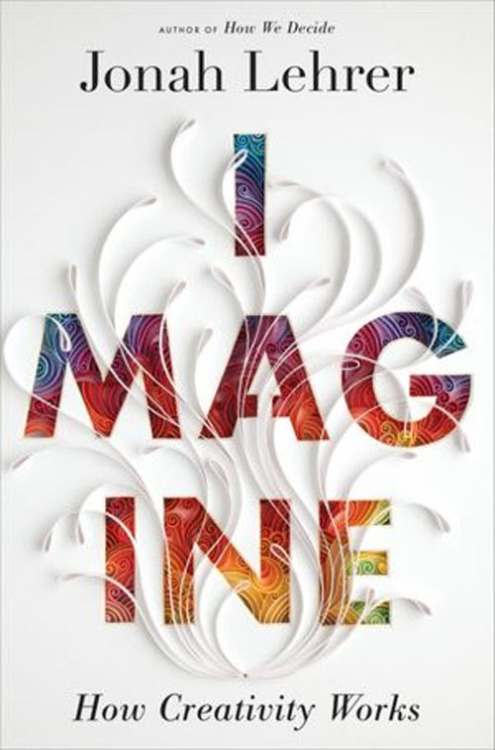
It was the literary Braxton Hicks contractions that moved me to read Imagine: How Creativity Works by Jonah Lehrer. I’m not going to review it today except to tell you that it’s good enough to bleed yellow from all the passages I highlighted as I read.

One thing I wished for was a set of bullet points at the end of each chapter to tell me what to do, now that I was so smart about Bob Dylan and cellophane tape and the prefrontal-cortex. But there were no such points, and I’m sure the reason was that Lehrer meant to inform creatives of all sorts, and bulleted action points would differ for each reader.

No matter. I took all the highlights I'd made, and fashioned my own bullets. And today I will share them with you:


  • Embrace despair. 
    • That terrible moment when you want to throw your computer and your vocation out the window is actually a good thing.  It’s what a breakthrough feels like just before it happens. 
    • To welcome despair into your life, work within a form. Poets limit themselves with rhyme and meter because they know that a fenced imagination tends to expand to fill the empty spaces within those limits. If the writer doesn’t wimp out and grab the easy, almost right word because it rhymes, he will be blessed with a word that’s more than right, one that startles the reader with a flash of new light. 
    • Of course, a novelist doesn’t write sonnets, so her forms will be more subtle.  One solution is to follow the advice of William Shakespeare, to strive to reflect “the very age and body of the time,” to use the world we live in as our “form and pressure.” 
  • Be bipolar.
    • Remember that there are two kinds of thinking involved in writing, and each makes its own demands.
    • Divergent thinking is the kind that gathers from the chaos of information around us to make new and startling associations. Much of your first draft will be written in this state of mind. (In Zen And the Art of Writing, Ray Bradbury advocates writing the whole thing in one fast, passionate, wild burst.) What it feels like is a burst of insight that seems to come from nowhere. (Imagine explains where it actually comes from.) You won’t reason yourself into a burst of insight. You have to look away, daydream, and let it sneak up on you. This means you need a time of unfocused relaxation before you write, a pleasant boredom in which you let your thoughts wander – but watch where they go. You know it’s time to daydream, to take a walk, a country drive, or a long shower, when you feel that the thing you're looking for is just inches away, but you can’t grasp it. It helps if you’re in a good mood when this kind of insight is needed. If you’re not, try watching a funny movie. Bursts of insight are happy sorts, and they hang around smiling people. (Who knew daydreaming was good?)
    • Analytical thinking is different. It’s the kind of thinking that shuts out the chaos of information so it can focus in on the one thing concealed in the chaos that really matters. You know this kind of creativity is needed when you sense that you will arrive at your answer if you sit down and work it out. It's the kind of thinking needed when you edit your work. Unlike Divergent thinking, Analytical thinking prefers a slightly sad state of mind. Something about a mild depression helps you focus for longer periods of time. If you need to work something out and find that you are feeling too happy, try watching a sad movie to get in the spirit of things. (Who knew that depression was good?)
  • Silence the censor. 
    • You already know this. The book will tell you what amazing thing happens when that particular part of the brain (your censor has a location) is damaged or stunned into silence. If brain surgery does not appeal to you, you can try these exercises in your journal, to harrass the censor into mortified silence (based on exercises used in the Second City theater and training center in Los Angeles):
      • Write something silly and innapropriate.  Push the limits. Write something you’ll want to burn before anyone sees it. 
      • Rant about something that makes you angry. Get disproportionally, over the top angry. Scream on paper. Write something you will have to burn before anyone sees it. 
      • Write something deeply, mortifyingly confessional, something no one knows and no one should. Tell everything. Make positively sure you burn it before anyone sees it. 
  • Knock yourself off center. 
    • Travel. 
    • Move to a city full of imigrants and hippies and skinheads. 
    • If you can’t do either of these, find a way to hang out with people who are not like you, who don’t agree with you, who know more than you, or think they do. Share ideas, and listen to the ideas of others so you can steal them and form them into something new. Be an outsider, because outsiders have to stretch. DO NOT accept unqualified positive feedback. You need constructive criticism to move your thinking in new directions. Criticism – even if it’s wrong – will open you up to fresh surprises. 

This post is no substitute for the book itself. The points here only brush the surface, and the stories and studies beneath them are fascinating and mind expanding.

Does any of this speak to you especially? Please do tell. We love to read what you have to say.


Wednesday, March 28, 2012

Reading as a Writer

Alice Kuipers joined us this week, with an interview about writing, her books, and the process of figuring it all out. She also talked about reading fifty pages a day, and her habit of buying a book a week in her chosen genre.
These are important habits for a writer. The simpatico between reading and writing cannot be overstated. I've noticed over the past year or so, that my reading material has changed in some interesting ways. I'm reading Ibsen's dramas, sixteenth century plays and poetry, literary anthologies (those clonky honker books you were forced to buy for your Introduction to English Literature class), sociology books, history, and short story. I have so many books on order at the library I have my own shelf in the "hold" section.

This is unusual for me. Often, I have two books at a time on the go, a fiction and a non-fiction. I very much like to keep up with current releases, and I follow some of my favourite publisher's releases (yes, I have favourite publishers).  So what's going on with my reading selections? I've made a list of my observations about my reading that I think might be useful to other writers.

1. Reading sometimes takes us where we're going, not where we are right now as writers.
     The unusual assortment of classic literature, plays, and poetry piled by my bedside isn't an attempt to appear cultured (the pile is in my bedroom, the only people who see it is me, my husband, and our kids. And the dog, but she only likes the comics). I'm not trying to be a smartypants, I'm hunting for something. I don't even know what it is I'm looking for, but my brain--which often operates independently of me--knows where I lack as a writer, and has decided that the answers lie in pursuing dense literature. My only hope is that when my brain figures out what it needs, it will tell me and then we'll both know.
     I'm not implying that I intend to write dense literary novels. What I hope is that, one day, I will produce a novel of substance. Something enduring because it hits the right human notes. The more I read diverse, dense literature, the closer my brain gets to figuring out how I might accomplish this.

2. Enduring literature (classics) deserve our adult attention.
     I'm ashamed to admit I don't own a copy of To Kill a Mockingbird. That's just wrong. I further admit that I merely skimmed The Grapes of Wrath in high school. The Old Man and the Sea numbed my sixteen year old mind so thoroughly I avoided Hemingway completely until I was over thirty-five. These, and so many other novels, endure because they are important, yes, but also because they are the perfect blend of right-now culture, human struggle, and culturally transcending truth. I need to learn this. I need to erase the prejudice from my youth, and embrace these novels as an adult. Whatever I think about them is wrong. I need to discover them anew.

3. Reading plays sharpens skills for creating plot.
     Ibsen was a complete failure until he was a smash success. Once he ditched the idea that his plays should be written in rhyming couplets, he allowed plot to take the wheel and he produced plays of such shocking humanity certain countries forced him to re-write the endings. Plot revealed completely through dialogue. Mastering such a skill promises boundless possibilities to the novelist. It is my vow to study as least three plays a month.

4. Poetry is nonnegotiable. 
     I was dumb for too long, believing all that smugness about good poetry versus bad poetry. Intimidated, I avoided the question entirely for years. Believed I could live without poetry, that I wasn't missing anything important either as a reader or as a writer. Dumb, dumb, dumb.
     Happily, my brain, which was, once again, acting without first consulting me, caused me to pick up a collection of poetry complied by Garrison Keillor. I began to read. I rummaged in the basement and found old collections, thick with dust. I am converted. I now turn to poetry as I do the Psalms. Writer, read poetry. Period.

Share with us a bit of your reading life. Has it changed recently? What are you learning about how and what you read?
     

Monday, March 26, 2012

Interview with Alice Kuipers, Author of 40 Things I Want to Tell You.


We're excited to welcome Alice Kuipers to the blog today. Alice was born in London, England, and moved to Canada in 2003. She lives Saskatoon, Saskatchewan, which took her a while for me to learn how to spell.  
Her first novel, Life on the Refrigerator Door, was published in 28 countries, won several awards and was named as a New York Times book for the Teen Age. Her second is called Lost For Words in the US, and The Worst Thing She Ever Did everywhere else. It won the Arthur Ellis Award, was shortlisted for the White Pine and Willow Awards, and was published in eight territories.  Forty Things I Want To Tell You is her newest novel for young adults.  The Best-Ever Bookworm Book by Violet and Victor Small is her first picture book.  It’s in production with Little, Brown Books For Young Readers, and a sequel will follow.

She's had non-fiction published in Easy Living Magazine, the Sunday Telegraph and the Bristol Review of Books; several short stories turned into radio productions; and one short story which was used to inspire a short film. She won the LG award in Saskatchewan for most promising artist under 30, when she was under 30, not soooo long ago. Please visit her website for writing tips, news about her books, and writing prompts!

Novel Matters: Alice, You recently completed a one year stint as Saskatoon Public Library Writer in Residence where you met with many writers to talk about their work. Tell us about this experience, and how it influenced you as a writer. Were there any patterns you saw as you read the work of new writers? Any advice you'd like to share?

Alice Kuipers: The residency taught me how much of a role writing plays in the lives of so many people in the community.  I was astonished by how many writers I met, and how many of them wanted to share their work with me. I divided the writers up in my mind into two groups – one group wanted to rush the work out to publication, and had no trouble writing loads of stories and ideas down, but needed to spend a bit more time editing, perhaps.  The other group felt overwhelmed by the blank page, wanting to get the words down but worrying that they weren’t good enough.  It seems to me that there are two stages to the writing process.  The first stage is when you write for yourself – and the first group was good at this.  The second stage is when you polish the draft for publication, so you write for someone else.  The second group was excellent at this, but they forgot the first stage.  I tried to encourage each writer I met to work hardest on the stage they found difficult.

NM:  What a great perspective. I don’t think I’ve heard it expressed that way before. Gets me thinking about which group I fit into. I think both at different times. With all your experience with new writers, what is the best piece of writing advice you have to offer aspiring authors?

AK: Write. Really, sit down and get writing. Your story is worth telling.

NM:  Deceptively simple advice, Alice, but that is what makes it the best advice. In the end, it takes a great deal of faith and self-permission to put your butt in the chair and write. Okay, what is the worst piece of writing advice someone ever offered to you and why?

AK: My art teacher insisted I had to do a sketch and preparation for every piece of art work at school. It was terrible advice for me as I never prepare.  I prefer to edit something a thousand times but the first draft is a thrilling ride for me alone.  My art teacher had a different way of working and tried to enforce her way of working artistically upon me.  I’d extrapolate from this that it’s not a good idea to try and follow someone else’s work practice when you’re doing something creative.  Find your own way.

NM:  Finding your own way is great advice. It’s time consuming, and even frustrating at times, but it’s the only way. So, when you need a break from finding your own way, what is the one non-writing thing you do that helps you be a better writer?

AK: Other than reading? I guess hanging out with my children.  One of them is yelling at me right now.  I’ll be back!

Yes, hanging out with my children is so time consuming that it involves all of my brain and I can’t think about writing at all.  When I get to the blank page, I sometimes feel like weeks have gone by and so I’m ready to work with new insights and able to see the page almost as if I hadn’t written it in the first place.

NM: I’m still thinking about your art teacher. There is a big different between being influenced in a positive way by other writers, and trying to bend ourselves into a pretzel imitating them. It’s almost like we need to read and read and be inspired but at the same time remain true to our unique vision and way of doing things. Which novels have informed you as a writer over the years? In what ways have they influenced you?

AK: I read as much as I possibly can, all the time.  The novel I most loved is called The Glass Bead Game by Herman Hesse.  A friend of mine read it after I suggested it and he actually thought I was joking, as the book is dense and hard work.  But there is a moment within the novel of such great beauty that I was profoundly moved when I read it and this moment has stayed with me.  Every year, I try and read the Booker shortlist, several of the GGs (Governor General—book awards for the best English language and French language books in Canada ) and I buy at least one young adult novel a week.  I’m just about to sit down and read a book called Mad Love as recommended by the fifteen year old I live with.  Books are the soil from which a writer grows.  My only writing rule is to read (50 pages a day) and from all those books, I think the words I write bear fruit.

NM: One thing every writer loves is another title to check out and add to their to-be-read pile. I know I’ll be adding The Glass Bead Game. With all the reading you do, is there a writer in history, or living today, you’d love to sit down and chat with? Who would it be and why?

AK: Well, other than my darling boyfriend (Yann Martel), I think I’d enjoy hanging out with Tennessee Williams.  I’m sure the way he spoke would teach me so much about writing dialogue and I’d love to ask him about The Glass Menagerie, my favourite play.

NM: Tennessee Williams wrote brilliant character studies, rich, complex, dark, and utterly human. When you begin a book, do characters come to you first, or does plot, themes, or something else?

AK: Titles come to me first.  Often I end up changing the title later on, but something about the selection of words giving me the framework for the story helps me get started.  There’s often a feeling too, a question I want to answer for myself.  Everything else follows.

NM: Was the title what came first for you when you began your latest Novel, 40 Things I want to Tell You? (amazon link)

AK: The title paired with the name of the character.  I liked the juxtaposition of a girl who wants to fly being someone who is terribly controlling because she’s scared of letting go.

NM: 40 Things I Want to Tell You (kindle link) is about a girl who seems to have the perfect life, until the perfect storm of problems, including a love triangle, start cracking her perfect world. What do you hope your readers to carry away from reading your novel?

AK: I think it’s important to be okay with not always being in control.  Trust what your instincts tell you.  It takes Bird a long time to realize this.

NM: I’m still working on that one myself. Writing a story like this one obviously took courage on your part. You had to trust your own instincts. What did you gain from writing 40 Things I Want to Tell You? (Canadian link)

AK: I learned a huge amount about rewriting with 40 Things and with the book before it, The Worst Thing She Ever Did.  A good editor should be brave enough to ask you hard questions and a writer should be brave enough to find those answers.  I was lucky to have a good (different) editor for each novel.

NM: This year, our blog is exploring the question: Why does the novel matter? How do you answer this question?

AK: The novel matters to me on many levels.  Personally, the thrill of reading, of being consumed by a story so much so that the real world ceases to exist, is one of the great joys of my life. Intellectually, it allows me to live other lives, explore other realities, exist in places and in ways I never could otherwise.  Emotionally, I have experienced things that buffer me for the challenges and joys of my real life.  Novels matter to my family because both my partner and I live by our writing, and because our children are at the stage where they are learning to speak so the words and sentences they hear from us are inspired by the words we read and write.  As a form, the novel matters because it is one of the best contemporary ways to encapsulate story without visual influence – letting our imaginations as readers do the work that other mediums may not allow.  Story is essential to being human, I believe, and novels give us those deep, meaningful, powerful, crazy, life-enhancing stories that make us who we are.
 

Thank you so much, Alice, for being here today. Your insights are inspiring, and we all appreciate your encouragement and positive out look.

As always, dear reader, we welcome your questions, comments, ideas, insights, and chocolate chip cookies.

Friday, March 23, 2012

Negative Talk

"I can't really call myself a writer until I've sold something. This negative self-talk can be safe to hide behind. If we never state that we are writers no one will expect us to produce anything and we can avoid those awkward questions about when we are going to finish that book."

This portion of Debbie's post on Wednesday got me thinking about a couple -- we'll call them F & J -- my husband and I are friends with. While my husband Rick and F have a great deal in common, J and I, on the surface, are an unlikely pair. We had gone to church together for several years, but our social paths never crossed. It was my novel, Lying on Sunday, that caused us to connect, because of a reference, of all things, to the Beatles. She and I both loved/love the Beatles and both saw them in concert at the same venue. We spend a lot of time together as couples, but Rick and F often meet for lunch, and J and I do as well. She and I also love to take in a matinee of movies our husbands might not be interested in seeing.

F is an attorney, and like Rick, he's a history buff and a huge baseball fan. In fact, they've traveled to Southern California together to see their favorite teams: the Angels for F, and the Dodgers for Rick. Go, Blue!! F has been working on a memoir of his life for about 25 years, and while he loves to talk about it, the progress has been s-l-o-w.

J is an ovarian cancer survivor. She is building a speaking platform as an inspirational humorist. And believe me, she is funny. She too is writing a book about her experience, but it's very upbeat and meant to encourage a reader who's going through any kind of serious trial. Within a few months she had a strong first draft completed. She and F share a cluttered home office, sitting back to back as they work at their computers, and it truly is a case of the tortoise and the hare. Only this time, my money is on the bunny.

F & J have two very different projects going. I've been helping J with her format and advising her on how best to proceed so that she'll have her book available for her speaking engagements. In the late fall, she was gung-ho and moving forward. Her goal was to have the book finished and ready for self-publication after the first of the year . . . until F began to undermine her confidence. Now, ordinarily, F is positive, kind, a real gentleman to his family and friends. But he has been surprisingly critical of J's book. He doesn't "get" the humor -- which is aimed exclusively at women, and has brought me to uncontrolled laughter even after reading a particular excerpt two or three times! He doesn't "get" why you'd use bold subtitles at the start of a section. Those aren't in any of the books he reads, which are typically biographies of historical figures, and he's right, you won't find them there. "Besides," he says, "the subtitle gives everything away." Well, yes. And it makes a particular topic very easy to find for a reader who wants to revisit it, which is one of the reasons you use them. He doesn't "get" why she'd consider self-publication, which, in my opinion, is her only real option. In short, he doesn't "get" why her book doesn't look like his book.

J began to second guess everything she'd done, and stopped working on her project. The negative talk that Debbie spoke about had its affect on J. It wasn't self-talk, as Debbie described, but it was just as damaging. Fortunately, J came to her senses and sat her husband down for a heart-to-heart talk. She explained that her project was nothing like his, and therefore would have a completely different style than his. She made it clear that he either needed to encourage her or keep his opinion to himself. Now she's back at work. Unfortunately, because of the delay, she won't have the book to sell at an upcoming speaking engagement, but hopefully she will have it for the next.

There are a host of negative aspects of being a writer. We've talked about them a lot at Novel Matters. It's a solitary endeavor, filled with fear, doubt, discouragement. But when we're assailed with the negativity we have to pick ourselves up by the scruff and keep at it.
Does any of this resonate with you? When the negativity comes, whether from external or internal forces, how do you combat it? Who is the one person you can count on to encourage you?

Wednesday, March 21, 2012

Spring Cleaning Tips


I would like to wish everyone a 'Happy Spring.' At this time last year, I posted about spring cleaning in the broader sense of the word as it pertained to writers, but today I'd like to focus specifically on refreshing our thoughts, attitudes and self-talk.

It's amazing how during a long, dark winter you can turn a blind eye to the staleness, grime and clutter that accumulates. Throw open those windows and let some fresh air in!
  • I write exclusively (insert fiction, non-fiction, romance, historicals, contemporaries, etc.) When we make this statement and put a period at the end, we limit the scope of our writing. We're saying that there is no room for God to do something new and fresh in us and we miss out on the possibilities. I'm not referring to genre-hopping. We need to build a brand and that takes time, but we can't be arrogant enough to assume that we know the mind of God. Leave yourself open to variety and to God's direction. This means that if we see ourselves as book writers, we should not close the door on short stories, personal experience pieces, magazine articles, or other forms of spreading God's story.
  • I can't really call myself a writer until I've sold something. This negative self-talk can be safe to hide behind. If we never state that we are writers no one will expect us to produce anything and we can avoid those awkward questions about when we are going to finish that book. And if we don't think of ourselves as professionals we can become complacent and not apply ourselves as we should, which is terribly convenient when we don't want to put in the long hours it might take to complete something of value.
  • I should only write what I know Writing what we know is a great place to start, but don't get stuck there. Ray Bradbury, while a lover of science fiction, had not gone into space himself when he wrote The Martian Chronicles (except in his imagination). At the very least, writing something completely different can be a great writing exercise that gets the creative juices flowing.
  • I don't really value (insert fiction, non-fiction, romance, historicals, contemporaries, etc.) This is arrogance, pure and simple. I'll admit I've been a book snob. I'm not referring to discernment about the quality of a book - I have devalued certain genres. Who am I to make that judgment? Just because it's not my favorite type of book doesn't make it less valuable. Wouldn't it be the funniest of jokes if God laid that kernel of a story in my imagination? He does have a sense of humor, you know.
  • I don't need anyone else to critique my writing This lone wolf mentality can only hurt your writing. If you aren't ready to accept constructive criticism, forget about submitting it to an editor. You're not ready. And I'm not talking about your mom - she loves you - I mean a small group of like-minded writers who will be gently honest and affirming at the same time. It takes time to find a group like this, but it's worth it.
  • I don't have time to write on a regular schedule I'm not buyin' it. You may not have a large block of time right now, but sit down and make a list of unclaimed moments that you have at your disposal. I'll bet the time adds up. When you're waiting at the doctor's office, riding the bus, early weekend mornings before your family is up or late at night when the house is quiet. It's not how much time, but your commitment to carving it out.
  • I can't justify investing in (books, conferences, retreats) Check out second-hand bookstores, 'Friends of the Library' sales, Amazon (cheap used books), half.com and conference scholarships. Following writing blogs is free. Make your own writing retreat: take your notebook/notecards/laptop to a library's quiet room or take your lunch to a local park. Even better, partner with someone to add the dimension of feedback. If you are seriously following God's call to write, at some point you will need to attend a major writing conference such as Mount Hermon's Christian Writers Conference.

What attitudes or self-talk are holding you back? We'd love to hear!

Monday, March 19, 2012

Daydreams of Being an Author -- A Novel Matters Roundtable

If there's any dream that writers have, it is of how his or her life will change with the publication of that first book.

People will respect you. They will see you differently. They may wonder what notes you are jotting down. You will inspire awe and mystery. Someone will call you and want to interview you. They may ask for your opinion, or offer you a free lunch. Your mother in law may treat you with deference. Your children will not sneak away from your car parked outside the school.

Oh, really? When my first book was published, I got no respect. I was a 29 year old blonde with two small children and many people all but called me a liar when I told them I had a contract with Zondervan to publish my book. Even when it came out, it didn't get better. Once I watched a friend of mine talking to a stranger who was going on and on about how great that book was. My friend finally interrupted her and said, "Here is the author of that book!" The stranger put her hand on her hip, looked me up and down, and said, "You wrote that book? Well, who helped you?"

And about your relatives respecting you. All that changed with my relatives is that I effectively trained them to expect free books every time I had a new release. To my knowledge, the whole extended family hasn't bought a total of two dozen of my books (and I have 16 that have been published.)

My other NovelMatters ladies: What dreams did you have about how your life would change once your first book was published? Did those dreams come true?
~


Funny you should select this topic for our Roundtable discussion, Latayne. I was thinking about this very thing just today. For me, my first published novel came so long after I’d begun to write fiction with the hope of being a well-published novelist—21 years in fact—that I was under no illusion that people would suddenly see me differently. My family and friends knew how long I struggled toward publication, and most everyone outside my immediate family probably thought I’d never achieve it. And when it finally came, it came not with a shout, but with a whimper.

I think most people outside my family assumed I had self published. No one expected me to land a contract with a major publisher, certainly not Zondervan (you go, girl!), and no one expected me to “hit it big.” They didn’t say that in so many words, but the message came through loud and clear. I think it’s the whole “prophet without honor in his own home” thing. Still, they were happy for me that my dream was coming true.

My books sold well among my church family, and it was only after people began to read my work that they began to take me seriously as a writer. That’s been a huge redeeming factor for me. People are taking me more seriously than ever before. And that matters so much.

That was my reality.

But this was my dream: That my debut novel would be well received by the masses; that they would anxiously await my next novel, and my next. There are a few hundred who fall into that category, but, alas, a few hundred fans will not a best seller make. I had hoped that my “career” would gain momentum with each new release, even if it was slow and steady. But I published with a company that was experimenting with fiction, and when their experiment failed, I was caught in the fallout. The third book in my contract was cancelled, and even as a client of  one of the most respected agents in CBA, I’ve been unable to find another publisher. So now I am going the self-publishing route. I’m releasing my next novel, Unraveled, in April, and I’m thrilled to have something new to offer my readers. I will continue to write and persevere, because it’s what I’m meant to do. It’s not my identity. I’m Sharon K. Souza, wife, mother, grandmother, sister, friend, daughter of the Most High God. But it is my calling. I want to do it to the best of my ability, for as long as I can, and I pray that my work accomplishes the purpose God intends for it.
 ~
I remember the day I learned that multiple publishers were vying for my novel. In between phone calls, I scrubbed toilets and washed floors. I was excited, obviously, but my house was dirty and my children needed me, and I was still too swept up in day to day living to think too much about what being published might mean.

I had a great deal to learn about the marketplace. How books were sold, how they were moved, and how selling your novel to a large retailer like Walmart and Costco could actually hurt your books sales. Mostly, I had to learn the hard lesson that CBA isn't where my fiction belongs. The stories I write don't fit with the wonderful CBA readers, nor meet their needs. I had to make the painful decision to move from CBA to the general market. I signed with a wonderful agent in New York, but I didn't tell anyone. What was the point? She now has two of my novels, she is shopping one hard. What do I expect will happen to me when that novel sells? I will continue to put one foot in front of the other, will keep writing novels, keep improving as a writer. That's truly all I know. I've never nursed dreams of wild success (whatever that means), or earning the respect of my peers (I'm way too much of a misfit for anything to really help in that area), or making millions. Some money would be nice, but I've learned that the world writer is often preceded by the word starving for a reason. I don't have any dreams to dash. But I have learned how incredibly difficult publishing is, and how it demands more than it gives back.  
~
Latayne, my very humble dream was to revolutionize Christian fiction. I haven't quite achieved my goal yet, so I'm rethinking my goals. Perhaps it is enough to write the very best story God has equipped me to write and leave the results to Him. Iím pretty excited about this new direction.

I enjoyed your story about the person who asked who helped you write your first book. It reminds me of a day I went shopping with my mom, a born publicist. Mom can turn any conversation to include that I happen to be a published author. The proprietor of the store, a man, raised his eyebrows and asked, is it a cookbook
?
~

I thought I would be thinner - don't ask why, since the activities that make one an author pretty much define "sedentary occupation." I also thought getting published would make me more interesting, which is also odd since the activities that make one an author ... well, you know.

I did hope that I could tell people I was a writer without risking that skeptical smirk these ladies have already mentioned.

But I still rarely tell people I'm a writer, because while they seldom smirk, they tend instead to lavish attention on distinguished author me. No one is more surprised than I am to learn that I don't much like lavish attention.

When I sold To Dance In The Desert, I returned home to a big party and a banner over the porch that read, "Author Author." I thought I'd leave that banner up forever, till the first beautiful summer morning when I took my laptop to the porch to work on my edits while the sprinklers ran. I looked up from my work to see cars slowing so the drivers could glance first at the banner and then at me and my laptop, like I was some sort of carnival display. The bits of tape that held the banner are still there.

There is one thing I hoped for that did pan out:

I hoped my books would mean to someone somewhere what certain favorite books have meant to me. I hoped that readers would write to tell me that their sight was clearer, their souls more open, the darkness lifted just a little. It pleases me immensely that I've heard such things from my readers, some of whom are reading this post today. 

~
The future I envisioned after selling my first book involved submitting my two-week notice at work and staying home every day to write.  I knew it wouldn't happen overnight, but I hoped it would be a reality. So far, it hasn't.

Also, I never realized how humbling book signings could be. Sometimes they were so rewarding, and it was always wonderful to meet readers, but there were other times that involved sitting at a table for hours with people walking past avoiding eye contact.  Awkward, to say the least, but not out of the ordinary for an author just starting out. There was much more involved than simply showing up. A successful book signing involved having a build-in audience, which isn't always possible.  

Friday, March 16, 2012

Shining a Light on Monsters


OOPS! I skipped a chapter in our discussion of Anne Lamott's Bird by Bird last time. Here it is! Jump in whether you've read the chapter or not. Also, is there a writing book you would like to discuss together here? We're almost to the end of Lamott's book.

Lamott's chapter, "Finding Your Voice," opens rather predictably but wisely about how new writers tend to emulate their favorite authors:


It is natural to take on someone else's style, that it's a prop that you use for a while until you have to give it back. And it just might take you to the thing that is not on loan, the thing that is real and true: your own voice.--Anne Lamott, Bird by Bird

Early in my writing career, I read everything by Elizabeth Berg. I LOVED her voice, the truth of it, how I felt connected to her characters, with her. I loved her writing so much I attended a writers conference where she was a speaker, hoping to meet her. The poor woman was at the tail end of a book tour. She looked like she'd slept in motel rooms lit by strobe lights for weeks. The good thing for me? She was weak and easy to stalk. I wrangled a picture with her, a few words that I don't remember, but it didn't help me sound just like her.

As much as I wanted to write in her voice, I wasn't Elizabeth Berg. I hadn't lived her life, wrestled her monsters, eaten her breakfast, argued with her husband over moldy towels. My voice is my own, a product of all that is dull and magnificent about me. It's what I fantacize about, tremble over, do in dark rooms with the shades drawn. Oh my! My voice is also what swells my heart to love, rejoice, and worship. There's no getting around it, I can only write from my own core.

This, according to Lamott, means getting in touch with our monsters.

Really?

Oh yeah.


When people shine a little light on their monster, we find out how similar most of our monsters are. The secrecy, the obfuscation, the fact that these monsters can only be hinted at, gives us the sense that they must be very bad indeed. But when pople let their monsters out for a little onstage interview, it turns out that we've all done or thought the same things, that this is our lot, our condition. We don't end up with a brand on our forehead. Instead, we compare notes.

I worried about myself even as a child. We had exposed aggragate stairs to the second floor that sort of floated. No risers. Somehow, I had gotten into my head that if I stepped on the third step from the top, a monster would reach between the steps, grab my leg, and pull me into the 5th Dimension where unspeakable torments awaited children. My maturing brain knew this couldn't be true, but the self-doubting part of my brain kept up this practice for an embarrassingly long time.

No one ever knew.

Until, in an unguarded moment, as an adult, I told someone I hardly knew. As it turned out, she had rituals that kept her safe from monsters in the bathroom--touch the hot water knob, the cold, and tap the faucet three times. No monsters in the bathroom! And so, as Lamott suggests, my new friend and I compared notes. And that's what our readers want to do, compare notes. They don't want to brand us, banish us, or beach us (in case you're a whale). They share our need to know we're not as weird or damaged as we thought. We're not alone.

Recently, the gifted and gorgeous Katy Popa suggested a book to me: The 90 Day Novel by Alan Watt. The author took me by the hand to lead me through the process of structuring and plotting my work in progress through daily writing exercises. Some of the writing prompts took me aback. He made me write about my biggest disappointments, tell things that no one knows about me, and what the source of my greatest shame happens to be. I've filled five notebooks with entries for myself and my characters.

Somewhere in the process, I thought to myself, "Wow, my character's voice is changing. She's real." I'm not sure how my subconcious accomplished this (Bonnie!), but shining a light on my monster has deepened my voice, made it more unique and infused it with truth. It's more me.

Lamott summarizes that telling the truth in our own voices is our nature. "Truth seems to want expression." I'm not sure it's our nature to tell the truth, but I do agree that truth wants expression.

Fortunately, not all truth is a cold, cold lake we have to plunge headlong into. Perhaps your truth is that there is so much more to life than what can be seen. Life is mysterious, wondrous, and its Creator is good. Lamott includes a quote toward the end of the chapter that took my breath away. Stephen Mitchell wrote about Job, saying this:


The physical body is acknowledged as dust, the personal drama is delusion. It is as if the world we perceive through our senses, that whole gorgeous and terrible pageant, were the breath-thin surface of a bubble, and everything else, inside and outside, is pure radiance. Both suffering and joy come then like a brief reflection, and death like a pin.

Let me dare to summarize this seemingly disjointed discussion on voice: While we are in the toddler stage of our writing, we will emulate--or try to emulate--our favorite authors. It's possible this sort of play will lead us to our true voice. But it usually doesn't. What does strengthen and develop our grown-up voice is courage--to face our monsters and to "expose the unexposed." All this work will give us a truer voice, and truth will connect us with our readers like nothing else.

There was Interview With a Vampire. How about Interview with [fill in your name here]'s Monster? If you dare, interview your monster and see how the experience influences your voice. Be sure to report back! Are you buying this? Is it necessary to face your monsters to develop a strong, unique voice? Have you laid a book down because the voice wasn't true? And what about this kinship with truth? Have you experienced that with an author? Here's one sentence from this chapter that could start a great conversation: "Write as if your parents are dead." Let's not waste it!