A Shout-Out to wonderful followers: Rachel, The Koala Bear Writer, Sharon M, Suzi Shepherd, Cathy Bryant, Booklover 323, Yvonne Olson, Kimberly Payne, Page McManus, and Laidlaw Photography. Thank you!
And don’t forget to post a comment about your best friend to be entered into a drawing to win Sharon K. Souza’s wonderful book, Lying on Sunday.
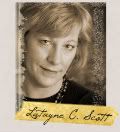
Author Latayne C. Scott
I’d like to introduce myself by saying that, since you’ve already met the other six authors, you’ll agree after reading my introduction: They’re nicer than me.
First of all, they’re six very loving people who reach out to others in a way I admire. I’m not equipped, I guess, to be able to nurture beginning writers in the way that some of them can do.
And secondly, a lot of people are angry about what I write. If you took a poll of the 13 million Mormons worldwide, many of those who have heard of me would say they hate me. Some have threatened me. I’ve written several non-fiction books about why I left the Mormonism I so deeply loved. One of them is the April release from Zondervan, The Mormon Mirage 3rd Edition.
My first novel portrays Mormons – the people – sympathetically, but turns a glaring searchlight on Mormon history and doctrines. So I will try to answer some questions from the point of view of my novel, Latter-day Cipher (Moody) which is, like The Mormon Mirage, available for pre-order on CBD, Amazon, and B&N. My editor called Cipher “the DaVinci Code of Mormonism,” and compared its insider view to The Godfather.
(And now I’m working on a new novel that promises to make some Christians mad or at least very uncomfortable. See, I warned you that I’m not that nice.)
Conflict is central to fiction, but how do you create a work of fiction that is tense, difficult, and sometimes even frightening, yet make it a place readers want to go to, spend time in, and get to know well?
I love reading mysteries – I began with Nancy Drew, and then read every single Agatha Christie and went on to a steady diet of modern mysteries. I love the technique of the cliffhanger, and have tried to use it in my novel, Latter-day Cipher.
But the cliffhanger is a trust agreement between the author and reader – the reader has to trust that the author will resolve it in a satisfying way. Not necessarily fix everything, but earn the reader’s respect for setting up the situation in the first place. Otherwise the reader won’t want to be played with again.
Where is the strangest place that you had a brainstorm and had to stop and write down an idea or snippet of dialogue?
My colleagues have teased me about the dream I had about a family that survived by eating wolves who had eaten corpses. That’s a scene in my novel.
I often awaken in the night and write down ideas, so I try to keep pen and paper nearby. One night I found the pen but it was too cold to go find some paper, so I just wrote all up and down my left arm, looping around, adding in things with carats. When I stumbled into the bathroom the next morning, my husband was shaving. He asked, “What is wrong with your arm?”
For the first moments, I didn’t know either. I wondered if I’d forgotten that I got a tattoo.
Which one of your characters most resembles you and how did you draw from your life to create them?
I thought I was being very subtle, but even before the release of Latter-day Cipher, people who read the manuscript said that I’m very much like the hard-headed agnostic reporter, Selonnah. She’s impatient with foolishness and people who talk too much. Okay, that’s me!
Tell us about the relationship between your writing and your spiritual life.
I guess because I deal in my writing with the way people wrestle with God, I’m a better writer when I’m spiritually off-balance. I do not welcome such feelings but I feel that God enables me to work through, and articulate, difficulties on behalf of others.
When you sit down to write, who is your audience?
As a novelist, I don’t write for Christians. I write for non-Christians. I want my writing to be understood without church-speak. In Latter-day Cipher I have a Christian character explain her faith by using some unusual images, but no Scripture quotations. My greatest goal is to be able to convey the truth of the Bible in a way that gains the respect of the unchurched reader.
What are your favorite things to do to take a break during a long writing session?
I hate breaks and interruptions. Therefore I don’t have any favorite thing to do except get back to writing. I’m really not much fun when I’m involved in a project. (See, not nice…)
Think of a novel you have not written - yet - but would like to one day. The best thing you will ever write before you die. Don't tell us what it will be about, but instead, tell us how it will make the reader feel.
The situations I depicted in Latter-day Cipher were those of the horror of losing one’s faith. I want a reader to feel that someone has looked in his or her soul, extracted the deepest, sick-swallowing fears and put them under a shadowless light.
For such readers, I want to examine in fiction those secret dreads and be able to tell them that there is a coherent, authentic way to find to answers that are transcendently, eternally true.
And, a real Person behind those answers.
Finally….
In subsequent posts, I want to talk less about myself and more about the writing process. But to conclude my introduction, here’s my branding statement, which sums it all up:
I pull an amorphous issue forward until it resolves into its face. Then I put my face right up against it and talk to it.
I take all comers: the monolith of Mormonism, the challenge of writing truthful fiction, the bittersweet contradictions of faith in a mysterious and terrifying God of love.
I look them all straight in the eye.
www.latayne.com
www.representationalresources.com
 Hello and top of the week to all you stimulating readers! Have we told you lately how much we enjoy interacting with you?