Monday, July 14, 2014

Summertime reruns: Starting a Novel

Today's Novel Matters rerun comes from Bonnie Grove. It first appeared in May, 2012.

Happy summer!

I’m not in the habit of quoting Zig Zigler, but the dude once said, "You don’t have to be great to start you have to start to be great." 

It’s a nice quote if you can picture saying it sans the fist-pump and jazzercise music playing ubiquitous at those brain-washing seminars.
 
Beginning a novel is daunting. Ever since Patti Hill talked about writing as stuffing an octopus into a mayonnaise jar, I haven’t been able to get the image out of my head. 
 
How does a writer go from holding an octopus in one hand and a mayonnaise jar in the other to a tidy stack of papers with his name neatly typed on the cover page?
 
If starting is the most crucial step (and it is), then starting well will save hours (months? Years?) of frustration in rewrites. 
 
Fiction is personal. No two writers come at it in the same way, and no one can say, “This is the definitive method of how to begin writing a novel.”
 
One writer begins with a character that shows up in her head and won’t go away. Another follows the crumbs of a plot, a series of “what if” questions. For another it’s the setting. Yet another (and this is how I usually begin) it’s theme. (update: I no longer begin a novel with theme alone. I've come to a point where I realize I must wait until a number of idea coalesce into a rich soup headed up by plot.)
 
Regardless of what jump-starts you to dive into writing a new novel, there are two questions you need to ask yourself before you put pen to paper. 
 
The first question is: Who is telling this story? 
 
When you discover the answer to this question, you lay the foundation for a myriad of complex literary devices. Discovering your narrator means you’ve discovered:

 Your setting. Real people live in real places—they come from somewhere. 
 When (in time and history). Narrators live in the present—even if they are dead (The Book Thief, American Beauty). 
 Which tense you will write in. Past tense (the current champion in novels everywhere), present tense? Which is best. Is anyone out there writing in future tense? 
 Voice. Ah voice, that misunderstood device of writing. Both simple and baffling. Knowing who is telling the story means you can listen deeply to that voice that lifts the words off the page and lives in the reader’s heart and mind. 
 And the biggest of them all Point of View (POV). Knowing your narrator means the POV (almost) decides itself. First person? Third person limited? Omniscient? Second person (rare, but wonderful when it’s done well)? 

Now, I’m not going to say that if you choose this kind of narrator then you automatically will have this kind of POV. It doesn’t work that way because each novel is different, and the more complex the story, the more layers of questions arise. 

But. 

If you spend a good chunk of time fiddling with the question of who, something amazing happens: you get traction under your story at the very beginning.
 
The second question to ask is: Why must this story be told now?

The word “now” is key to the question.  It’s not asking “is my story timely?” or, “is this culturally contextual?” Those are questions about things that lie outside your story. 
 
Why must this story be told now is a question that, when answered, brings a sense of intimacy, urgency, and intrigue to your novel. That tingly feeling you get when you open a novel and feel pulled in immediately. 
 
Why now? What desperate thing has happened that means the narrator is compelled to speak today. Now. Immediately. That not telling the story now would be wrong, perhaps tragic. 
 
Why is now the best time to tell the story? Knowing this will help you know where your story begins.
 
If you’re starting a new novel, ask yourself:
 
Who is telling this story?
Why does the storyteller need to tell this story NOW?

 
These questions will lead to more questions, which will lead to answers, which will lead to you typing THE END with a flourish.

Friday, July 11, 2014

Summertime Reruns: Swatting the Monkey


Once upon a time, Bonnie and I discussed in conversation certain changes she was making to the manuscript of her not-yet published novel, Fish.  I begged, “please, don’t change your protagonist.”

“What do you like about her?” Bonnie asked.

I explained that I like those times when I strongly suspect the character is clinically insane, but also suspect, just as strongly, that she may be God, himself. Something she says or does suggests a kind of wild love, and a profound knowing that gives me shivers.

Bonnie observed, “You like thin places.”

And I thought , “Of course. Don’t we all?”

Don’t you?

You know what thin places are, right? The ancient Celts used the term to describe places that were both one thing and another, and neither. The slope between the plane and the mountain is not mountain or plane,  and it is both. The shore between the land and the sea. The age between childhood and adulthood.  It was thought that these locations and times were holy places, where the veil between the physical and the spiritual was so thin, you could touch hand to hand with God through the cloth.  I’ve always wanted to touch hand to hand.

And after talking to Bonnie, it came to me that yes, this was exactly why I read.  The books I love are full of thin places, and the ones I don’t love… well, they aren’t.

There’s a book on my shelf, Christian Mythmakers by Roland Hein, that puts a name to this kind of writing. The name - you may have guessed – is “Myth,” and the definition Hein gives to myths is “stories which confront us with something transcendent and eternal.” Thin places, those stories that offer, as J.R.R. Tolkien said in On Fairy Stories, “a fleeting glimpse of Joy, Joy beyond the Walls of the world, poignant as grief.”

Joy poignant as grief. Couldn’t you spend a week thinking on that one?

One definition my dictionary gives for the word, “poignant” is “Keenly distressing to the mind or feelings.” I’ll admit, it’s the second definition, the first being simply, “arousing affect,” with little or no negative implications. But the kind of stories I like arouse a kind of joy that is heart-breakingly close to grief. I think that’s why I like the faith aspects of novels to stray into the unexpected. We expect God to peek out through the eyes of Father Flanagan. But when he reaches through the hands of the mentally ill, he touches me in the places of my own neuroses. When he descends on a cloud, that’s impressive, but when he calls through the voice of a broken minister (see Leaving Ruin, by Jeff Berryman), my own broken shards  become puzzle pieces, with at least a hope of wholeness.

It’s why crazyness and brokenness are so vital to a story. As GK Chesterton put it, “Fairy tales do not tell children the dragons exist. Children already know that dragons exist. Fairy tales tell children the dragons can be killed.”

We are all children in the inner layers, and we all have our dragons.

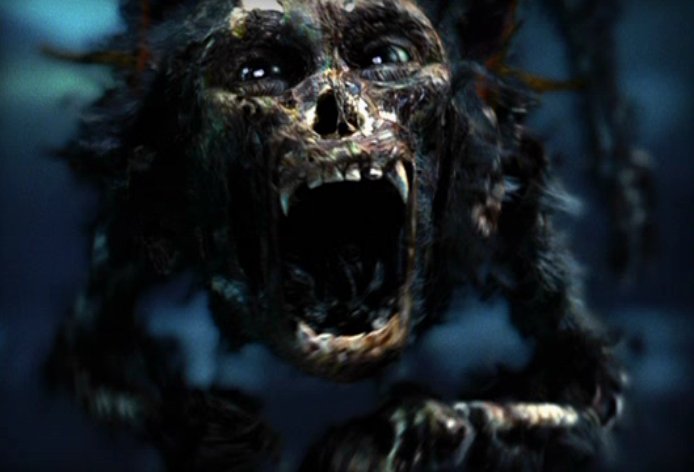
I think of a favorite scene in Pirates of the Caribbean, (the first one). Do you remember? A moonlit night, and Elizabeth (Keira Knightly) climbs a rope ladder to board The Black Pearl, even though the ship is overrun with cursed pirates that look like rotting corpses. Just when things are really tense, Jack the monkey confronts her full on, looking like the picture here. You can see what a terrible moment it is. But then it dawns on Elizabeth that this is just a monkey, after all. She gives the creature a look that says as much, swats at him, and he ducks his head and skulks away.

The new testament tells us of a devil defanged, defeated already, no matter what he tries. Oh Hell, where is your victory? Resist him and he will flee from you.

It’s like the story about Martin Luther – which may or may not have happened:  Luther awakes to find the devil himself seated on the end of his bed. He springs upright, prepared to scramble, till he takes a good look and says, “Oh, it’s only you,” and goes back to sleep.

What a story that is! Even if it isn't factual, it's true.

Just as thin places are true. We touch our hand to the veil, and another touches back.

What books are thin places for you? What about the story places your hand on the veil?

Do tell. We love to read what you have to say.


Wednesday, July 9, 2014

Summertime Reruns: To Read or Not to Read

This one appeared in May 2011.  Hope you are enjoying summer!

Mark Twain once said that a classic was “something that everybody wants to have read and nobody wants to read.” I guess English teachers were assigning some pretty dry reading in his day, too. It’s a rare student who can say they never met a classic they didn’t love, but there are some exceptions to Mr. Twain’s rule.
Hollywood knows how to tap into a good story, and that’s why there are movie versions of Wuthering Heights, Pride and Prejudice, Rebecca, Gone With the Wind, To Kill a Mockingbird, and more recently, Jane Eyre, to name a few. These may or may not be in your to-be-read pile, but seeing the movie often inspires me to read the book, and I’ll bet I’m not the only one.
Just what gets a book pegged with the dry moniker of ‘a classic’? I did some sleuthing, and the general consensus is that classics all share these traits:
  • Authentic storylines and plots that reflect social issues of the time
  • Idealistic characters. In the end, the good guys win.
  • Language that is intricate
  • A moral lesson
  • Longevity. Their popularity doesn’t diminish over time.
Christian fiction classics go a step further, having the ability to propel readers farther than simple messages of morality or social change can take them, to where they profoundly impact our patterns of thinking on a spiritual level.
If you did an online search of Christian classics, you would find some classics that are not labeled as Christian fiction but are steeped in Christian values, nonetheless. I’m thinking of L. M. Montgomery’s Anne of Green Gables and Louisa May Alcott’s Little Women, for example. Great, wholesome entertainment that sticks to your literary ribs.
But a Christian fiction classic is poised to help the reader go the step further, books like C.S Lewis’ The Screwtape Letters and The Chronicles of Narnia, Catherine Marshall’s Christy, John Bunyan’s The Pilgrim’s Progress and Lloyd C. Douglas’ The Robe. These classics have profoundly impacted me over the years. Others by Graham Greene and Flannery O’Connor have left their imprints on me, as well. There are, of course, many excellent Christian fiction books out there – many of them destined to become classics - but I mention these in particular because they are older and have withstood the test of time. It will be interesting to note which ones will make the grade 20 years from now. I predict that Francine Rivers’ Redeeming Love will make the list.
What have you read recently that changed you in some way and that you feel strongly will be a future classic?

Monday, July 7, 2014

Borges, the finishing and not finishing a book, the bittersweet

e           There is something eminently satisfying about knowing that you have finished a novel. Long ago, when I would finish typing a book (or printing it out) I would take the stack of papers, stand it on end, and tap them into place on my desk. That solid sound meant the job was done, and there is no other single sound of my life quite as fulfilling. 

But when the idea of a novel first intrudes itself into the mind, it is filled with endless possibilities, a quantum-mechanics-plethora of plotlines and character developments. Though my characters constantly surprise me with their unfolding, yet when I clothe them with word-skins, make their hair and habits consistent, and tell them they can only do certain things, that they must do certain things, there is a feeling of other universes that never will come to be. There are songs lilting through my head when I met them, songs they will never sing. There are dreams I could have given them, but did not. The infinity of their choices of paths will never be, for I, predestination's worst deity, have hobbled them to my own constrained map.

Finishing a book reminds me of a poem by Jorge Luis Borges (from a book loaned to me by my friend Price Daw), called "The Unending Gift," that speaks of all the limitless potential of an unfinished work of art (or literature.)

It is bittersweet--no?--to finish.


"The Unending Gift" by Jorge Luis Borges

                  A painter promised us a picture.
                 
                  Here in New England, having learned of his death, I felt once again the sadness of recognizing that we are but shapes of a dream. I thought about the man and the picture, both lost.
                 
                  (Only the gods can make promises, for they are deathless.)
                 
                  I thought about the place, chosen in advance, where the canvas will not hang.
                 
                  Later, I thought: if it were there, wouldn’t it in time become one thing more–an object, another of the vanities or habits of the house? Now the picture is limitless, unending, capable of taking any form or colour and bound to none.
                 
                  In some way, it exists. It will live and grow, like music, and will remain with me to the end. Thank you, Jorge Larco.
                 
                  (Also men can make promises, too,
                        for in a promise there is something that does not die).


How about you? Have you felt anything similar?  

Friday, July 4, 2014

Winner!

The winner of the contest Bonnie Grove ran this past week is:
vonildawrites!

Please email me at novelmatters@gmail.com and we'll get to work on your story!

Congrats!


Wednesday, July 2, 2014

Wagons Ho

I’ve debated for weeks whether or not I would write this post, but you who follow our blog are like good friends, and if I could sit down and have a glass of iced tea with you today, this is what I would tell you: As you read this, my husband and I are setting out on a move from one side of the country to the other. Believe me, this California girl never EVER thought she’d be leaving the Golden State, and certainly not for the hot and humid southeast. It’s surreal to me still as I say it. Well, if I’m going to be real, rather than surreal it’s more like living an episode of the Twilight Zone.

People keep saying, "Think of it as an adventure." But it doesn’t feel like an adventure. It feels exactly like what it is: an uprooting. And it’s painful. We’re leaving our family--which is the absolute worst part of this–our friends, and the community we’ve lived in since Rick and I got married 43 years ago.

People also say, "Think of all the new material you’ll have for your books." Well, the truth is I haven’t been short of material, and if I were, I think it would be easier to live with than this cross-country move.

The reason for the move is noble, but it doesn’t help. Maybe if I were more spiritual, it would. Or if I were less stubborn.

I have a lot of questions for God these days.

A lot of scriptures have been floating through my head, such as Romans 8:28: "And we know that in all things God works for the good of those who love him." And 1 Corinthians 10:13, which tells us God will not give us more than we can bear. But the truth is, I’m having a difficult time reconciling those scriptures to my circumstances. I know, that’s where 2 Corinthians 5:7 comes in: "We live by faith, not by sight." But right now it doesn’t help, because the tears in my physical eyes are clouding the vision of my spiritual eyes.

So if you think about it, I could really use your prayers the next few days as we drive our separate vehicles across country, and in the next few weeks as we acclimate to our new surroundings.

One really great thing coming out of this is that I’ll get to spend an hour or two with Latayne as we pass through her part of the country. We haven’t seen each other in more than 5 years, so you can imagine how excited I am about that.

Beyond that, if I seem a little lost in the weeks to come, you’ll know why.

Taking the Plunge into Novel Writing

I wrote this post in January 2009..five years ago and five years younger! I used one of my favorite quotes of Flannery O'Connor as a jumping-off point. Let's take the plunge...

People without hope do not write novels. Writing a novel is a terrible experience, during which the hair often falls out and the teeth decay. I'm always highly irritated by people who imply that writing fiction is an escape from reality. It is a plunge into reality and it's very shocking to the system. If the novelist is not sustained by a hope of money, then he must be sustained by a hope of salvation, or he simply won't survive the ordeal. --Flannery O'Connor, Mystery and Manners.

This is my favorite quote about novel writing. There's a touch of hyperbole in O'Connor's words (I still have my teeth!) but not much. A story owns the writer, not just for the hours set aside for tapping on computer keys, but while we sort lights from darks and wander down grocery aisles. We forget to eat, and yes, personal hygiene suffers. What's more, to write authentic fiction, we are forced to wrestle with God, dig deeper into what we believe about him and how he interacts with us and the world, and hopefully see him with fresh eyes.

Novel writing is not for the faint of heart!

But a deeper truth in O'Connor's words shakes me: Novelists plunge into reality. In our stories, we can rearrange topography, give an alien extra arms, or allow mythical characters into the landscape, but we cannot, must not, rescue our characters from their fallen natures or transfer them to a fall-less society (La-La Land), or save them from meaningful struggle. They will fail, not in a contrived, acceptable-to-Christian-culture way, but in a way that makes our own skin itch. That's when grace shows up.

Does this mean every novel should portray the underbelly of society?

No, but we disrespect our readers if we mishandle the human condition, both its nobility and frailty. After all, the Bible is wrought with counterexamples. Think of David; he committed adultery and sent the husband to certain death, and yet, he is the apple of God's eye. Peter denied Jesus. Judas betrayed him. Thomas forgot. Even Jesus struggled in the Garden of Gethsemane. The faith life is messy!

Now, it's your turn. Have you read a novel lately where the author plunges into reality and does it well? Tell us about it.