Showing posts with label Harper Lee. Show all posts

Monday, December 16, 2013

Party On! Novel Matters' Holiday Guest List

We're collecting our beaded chiffon evening gowns from the cleaners in preparation for the coming holiday season. Each of us has drawn up a guest list of authors--living or dead--to invite. We have our reasons for each inclusion, of course. Be sure to share who you would invite to your holiday party.

New Year's Eve is a quiet affair at the Hill house. Our farmer genes have gone into overdrive, so once the sun sets, well...But if I were to stay up long enough to welcome in 2014, here's who I would want to pass the popcorn with:

William Shakespeare. I lugged the complete works of Shakespeare around for 4 1/2 months to attend class with a dry-as-dirt professor. I imagined Will sitting at the back of the class, shaking his head and rolling his eyes. First and foremost, I believe Will was an entertainer. If people didn't come to his plays, he didn't have a job. Secondly, the man was a genius. He contextualized pressing questions within the iambic pentameter of his writing. I want to know if we go overboard sometimes with our interpretations. Now, if his naysayers are correct, and Will did not write the body of work we attribute to him, would the right and true author please RSVP immediately?

Emily Dickinson. I would be terribly shy in her presence, but once I gained her confidence with literary conversation, I would ask about her writings to the "Master." Were her steamier love poems written about him? Although a recluse, men did orbit in her sphere. Was there someone else? Yeah, you're right, I want to gossip with Emily. It is a party, right?

Steven King. Things might get a little boring, so I'll invite Steven, too. A live one. He has a lot to say about writing. A bit of a taskmaster, though. He might get us to dip our quills for a fresh start of writing for the new year. If that doesn't work, I'll ask, "Steve, could you tell us a story?" Of course, we would all stay awake to see the new year in. First, because the story would be enthralling. Second, because we would be afraid to close our eyes.

Heading my guest list would be Charles Dickens. I've been a fan for many years. I remember years ago getting a biography on Dickens, and it took me quite a while to gather the nerve to read it. My hesitation came from not wanting my image of him destroyed. Happily, I liked him even better after reading the biography. He would be an extremely entertaining guest.

Harper Lee would certainly be on my guest list. I know I've written about her before, but I would actually have two sets of questions for her. The first set would be geared toward the young Ms. Lee: what was it like to write a story like To Kill a Mockingbird as a young white woman in Alabama? What were the immediate repercussions? What, if anything, did it cost you? The second set of questions would be for the elderly Ms. Lee: At the time that you wrote Mockingbird, did you ever envision the changes that would ultimately take place in civil rights in your lifetime? And why, oh, why, did you not continue to publish your writing? I know I'd not be the only one to sit at her feet and listen to her answers.

And difficult as it is to narrow the list, I'd invite Suzanne Collins to talk about her amazing series, The Hunger Games. I'd like to ask about the inspiration for the novel series, and whether she's ever second-guessed herself regarding the love triangle between Katniss, Gale and Peeta.


William Shakespeare. I’d invite him too and share him with Patti. For one thing, I’d like to know if all that we attribute to him came out of his brain. Then I’d probably swoon and need to be resuscitated.

Charles Spurgeon. I have spent years of my life telling God “thank you” for this man’s incredible scholarship and insights. I’ve been reading The Treasury of David for over a decade, in fact. I can’t believe how much is crammed into that book. And if I could meet Spurgeon, I would wait on him hand and foot for the entire evening. The stories I’ve read of the depression he suffered during his last years breaks my heart, and I would love to make it up to him.

William Faulkner. I want to be him when I grow up as a writer. Sheer genius, and I’d tell him so and then leave him alone, which is what I think he’d want.

Corrie Ten Boom. I actually met her before she departed this life. But I’d like to sit quietly with her and let her tell me stories of her life.

Joyce Carol Oates. She’s still living, so I guess she might actually accept my invitation. (In my dreams.) She is brilliant and prolific in many genres. After I read Black Water, I thought she was the bravest novelist I had ever read.

Agatha Christie. A woman who loved both Egyptology and mysteries!  My kind of woman. And I’d want to know where she was during those 10 days in 1926.

Bonnie, Debbie, Katie, Patti, and Sharon. Truly, I would love to sit down with the most true-hearted writers God ever created. 

Latayne, I so agree. You all top my list!! One of these days we'll all be together again!


Anne Rice. I am currently reading her memoir Called Out of Darkness, A Spiritual Confession and I would love to hear firsthand about her journey back to relationship with Christ.  I know that since she wrote this book, she became disillusioned with the church, and I would like to talk with her about that, too.

Ray Bradbury. No surprise here - he would be top of my list. He captured my writerly imagination in my senior year when The Martian Chronicles was assigned reading.  I wrote him several times in his later years to tell him how his words had moved me to become a writer.  After he passed away, I was glad that I had not put it off.

Daphne du Maurier.  I think I read all her books growing up.  Her female characters were strong and self-reliant, or in Rebecca's case, grew to be so.  Her stories didn't fit into any one genre, and I think I was drawn to that. She never wrote with a formula and her endings weren't always neatly tied up. 
I agree with Latayne, we Novel Matters writers need another retreat. The last time we all met together was 2009. We're overdue.

My Christmas dinner party. I've actually thought about this often over the years with the guests changing on a regular basis. There are writers whose work I love. There are writers whose stories are so fascinating (by virtue of truth or myth) I want to include them at the party in an attempt to squeeze out the true story. There are questions I would ply certain writers with that have nothing to do with their work (Hey, Edgar, why did you refuse to drills and classes at West Point? And who brought roses to your grave every year?), and there are writers who I would invite simply because I want to listen to whatever they have to say, whatever they say. You can see how torturous this is for me to publish a definitive list. I'll call it a guest list in process. I'll be rearranging the name tags for all my life. Still, here are some thoughts:

Marilynne Robinson. I promise you I don't know enough about reform theology to keep up, but I'd like the chance to try.

Chaim Potok. Because we need a counterpoint to Robinson, and because I firmly believe they would bond over the pate and I would take notes.

Alice Munro. I'd give her a break from all the Nobel talk. Instead we'd talk being Canadian, and the subtle and not so subtle differences between Eastern Canada and the West. Our conversation would roam wide as the nation. And, because it's Alice, I'd bring up the role of women but not feminism, the way men understand the turn of the leg, but not misogyny.

J.D Salinger. Enough reclusive living, already. I'd invite him to confirm my suspicions of Post Traumatic Stress Disorder after The Battle of the Bulge. I'd serve him chamomile tea and he wouldn't have to talk if he didn't want to, but I'm certain Marilynne, Chaim, and Alice would draw him out and there would be a great healing for him and for the world.

Louisa May Alcott. She was her family's main source of income and so she learned to write fast (she wrote at least two works, Eight Cousins, and Little Men, in six weeks), and the stress was enormous. Addicted to morphine, and suffering from depression she eventually had to rent a room away from home just to be able to sleeps without the aid of drugs. I think she would sympathize with Salinger, and would benefit from the administrations of Potok and Robinson. Alice Munro would hold her hand and listen for hours and together they could carve out a better way.

~

Novel Matters wants to thank each and every one of our readers for making 2013 a Carpe Annum year. We've shared some amazing accomplishments, published books, and survived NaNoWriMo together. We have learned from each guest on the blog. It's been a wonderful year and we look forward to 2014 with you. We have some MAJOR ideas cooking, but, because they are still in their infancy, we will hold off revealing any details. What we can tell you is 2014 holds great promise and great reading.

Thank you so much for being a part of the Novel Matters community. We love this place where honesty, hope, and love mix together with ease. We wish you a Merry Christmas and a blessed and healthy New Year.

We will see you back here in January!

Monday, January 14, 2013

A New Year, A New Work

For 2013, we at Novel Matters are busy lining up interviews and guest posts with some amazing authors and industry professionals. We're starting off proud with Chris Fabry, whose gritty, suspenseful Western romance, Borders of the Heart, was released just last September. He'll visit us on January 28, so there's still time to read the book before his interview!

Carpe Annum! I love our theme for 2013. That's what the 6 of us plan to do, corporately and individually in the coming year, and I expect you do too. In my case I'm moving forward with indie publishing, and anticipate releasing my next novel on my birthday, July 1st. Happy birthday to me! I'm working hard at promoting Unraveled, and will soon re-release Every Good & Perfect Gift and Lying on Sunday, in both print and Kindle format. Yay!

As many of you can attest, there are a number of highlights in the life of an author: finishing a novel, signing that first contract, holding your published book in your hands, hearing from readers -- which really is one of the best things about being published. But another "best" for me is beginning a new manuscript. It's a thrill all its own, and holds so much promise. I can imagine Harper Lee sitting down to begin Mockingbird, creating one of the most enduring novels in literature, as told by one of the most endearing characters in literature, Scout Finch. I wonder how much Harper Lee knew about her story when she wrote that first paragraph. She could not possibly have imagined the lasting impact it would have on the world around her. She not only seized the year, she seized the ages. Wow. There's no end to the author studios our imaginations could take us to, envisioning ourselves looking over their shoulders as they penned, "Call me Ishmael." "Last night I dreamt I went to Manderley again." "It was the best of times, it was the worst of times ..."

As this new year begins, I've just begun work on a new manuscript. In December, I posted the prologue I wrote several months ago, but the prologue was as far as I'd gotten with the story. Yesterday I began Chapter 1. I'm so excited to be back at work. Since I began writing in the mid-80s I've had a novel in the works, without exception. Until 2012. I completed my last novel early in the year, and except for that prologue, I didn't write another word. I've said this before, I know, but usually by the time I'm 2/3 of the way through one manuscript, ideas for the next one are pounding at my door. I begin making a file for the new work as scenes present themselves and characters begin to take form. Dialogue is loud in my ears. I give myself a week or two after finishing one manuscript, then I'm right back at work on the next.

But there was much about 2012 that sapped my energy, both physically and mentally. (Do you sense how glad I am that 2012 is over?) I had ideas for two possible novels, but I couldn't make up my mind which way to go, and couldn't get traction on either one. I dabbled in plot and character development, going back and forth between the two, but nothing jelled. Then, in November, my daughter Mindy and I were making our every-7-week, hour-long trek to Folsom, where we get our hair done, when I brought up my dilemma. Mindy knew about my two possibilities, but as we talked about them, one of the ideas really began to click with me -- especially when Mindy threw out a terrific idea for a cover based on my working title. That settled it.

An odd way to decide on a novel to write? Perhaps. But simply put, it tipped the scales in favor of one topic over the other. And it gave me the enthusiasm that had been lacking. So for the past few weeks I've been expanding on plot ideas and character development, which is by far my favorite part of this early process. I love looking for the perfect names for my characters, and as I'm sure you've found, there are names that are exactly right for the people we create. I seldom hit on the right name, right off the bat. Instead, I try out a name, maybe even begin the writing with the wrong name, which will nag me until I find the right one. When I find the right first name, I search for the surname that fits. Then I go searching for the face to fit the name. Almost always, that's the point when a character comes to life for me.

But in the case of my current protagonist, her name came to me first, late one night when I was unable to sleep because of illness. It was as if she were suddenly there with me on the couch, introducing herself. A 12-year-old girl with an unusual name. And I said in a whisper, "What's your story?" And she began to tell me. Which was a bit unusual, because she doesn't speak.

Oh yes, there's nothing like beginning to write a new novel, to begin acquainting yourself with the characters who populate your fictional world; to discover the secrets they keep -- or try to; or to follow blindly along, not sure in the beginning what you'll uncover. It's as stimulating for me to uncover the plot of the books I write as it is the books I read. In both cases, there's always such great anticipation.

What about you? What's your favorite thing about starting a novel, as a reader and/or an author? And how do you plan to seize the year in 2013?

Friday, October 21, 2011

The Ultimate Interview

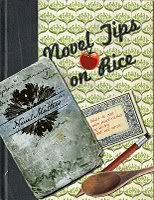
Another reminder: It's October and the holidays are just around the corner! A bound version of Novel Tips on Rice might be just the thing for that gift exchange at work, for your book club, as a hostess gift, or for that hard-to-buy-for friend. It's not only filled with some of our favorite recipes, but there are quotable quotes from the 6 of us, and the graphics in this little book are amazing. Consider giving yourself one as well. Contact us for more information.

Patti and Debbie gave us great advice and insight this week regarding the interview process, as well as sharing their own personal experiences. Expectations are a huge component of the process, especially on the part of the interviewee. One thing to note is that interviews of experts who can help in your WIP aren't just for authors who write non-fiction. Novelists also need the help and guidance of those who know more than they do about any given topic that pertains to their WIP. For example, I hope to schedule an interview with a weaver for the novel I plan to write next.

Since we're on the topic of interviews, I have a question for you. If you could interview anyone at all, famous or not, living or not, who would you choose? And what would your top two questions be for your subject? I know, narrowing it to one person seems nearly impossible. I'm sure we could all fill pages and pages with names of people we'd love to have a one-on-one conversation with. But for the sake of this exercise let's keep it to one person. I'll begin.
My interview would be with Harper Lee, author of To Kill a Mockingbird. She has fascinated me for many years. These would be my questions:


  1. What drove you into seclusion after writing one of the most beloved and influential novels of all time?


  2. I've heard it said you chose not to write -- or at least publish -- another novel after To Kill a Mockingbird because you feared you'd never equal the success you attained with that incredible novel. But what is the real story? What did it ultimately cost you to write your novel?
Now it's your turn. Who would you interview, and what would you ask?

Friday, August 5, 2011

What is True and Right


First things first! We'd like to wish our bonnie Bonnie a very happy birthday! Hope it's the best ever!

I especially like the chapter in Anne Lamott's Bird by Bird that Patti wrote about on Monday, "The Moral Point of View." Anne -- I love that we're on a first-name basis with her on this blog -- stated, "You need to put yourself at [the] center [of your stories], you and what you believe to be true or right. The core ethical concepts in which you most passionately believe are the language in which you are writing ... Telling these truths is your job" (pg. 103).

Ayn Rand, in The Art of Fiction, concurs. In the chapter, "How to Develop a Plot Ability," she writes: "You must start with the abstract idea of a conflict, but thereafter your own values (emphasis mine) and your personal imagination will be a reliable dramatic selector ... do not censor yourself or check yourself against your moral code. Simply tap your emotions; you can judge later whether they are right or wrong" (pg. 58).

Those quotes spoke to me on two levels: the micro and the macro. In the micro, I thought about some of the issues I've written about in my individual novels, all from the perspective of my moral center. For it's impossible for me to separate what I write from what I believe. I can write about characters who are my polar opposites, and about situations I hope never to find myself in. What I can't do is condone a type of morality that I don't believe in.

Anne Lamott says, "I'm not suggesting that you want to be an author who tells a story in order to teach a moral ... but we feel morally certain of some things ... and we need to communicate these things" (pg. 104). I completely agree. No one wants to read fiction that's written with a heavy hand, and I'm no exception. As I wrote in my previous NM post, Paying Attention to Detail, the novel I just finished reading was "nothing more than a treatise on the author's pet issues." I don't enjoy that any more than most readers. No matter how intense or deep the plot, I still read fiction for pleasure.

The key, then, is how we address our moral certainties in our writing. I think this is something Christian authors in particular struggle with, because we do believe so passionately in our values. We understand the implications of sharing truth from Scripture. But what we need to remember is that the blank page onto which we pour our words is not our bully pulpit.

Consider the novel To Kill a Mockingbird. Harper Lee didn't beat her readers over the head with the moral issues plaguing the South. She simply told a story -- an excellent story -- and let the story speak for itself.

So, does "writing what I believe to be true or right" apply to not only the ethics of what I write, but to the style and genre of what I write as well? I believe it does. It's what I mean by the macro. If a writer of CBA fiction based her writing choices on what sells best in CBA, her selection would be ... ahem ... somewhat limited. That's a topic the six of us discuss among ourselves, because, alas, none of us writes in those best-selling genres. All I can say about that is, DANG! Seriously -- oh, wait, that was seriously. Bottom line is we each have to write what we "believe to be true or right."

As I've mentioned before, I just finished a novel that took two years to write, and I have no idea if a publisher will ever pick it up. But it's a story I had to write, and I don't regret one minute of those two years. The few who have read it have said some remarkable things about it, and one way or another it will see the light of day.

A few days ago I received an email from a woman who won Lying on Sunday in a drawing. She liked it well enough that she ordered and read Every Good & Perfect Gift. This is what this woman -- who is battling pancreatic cancer -- wrote to me: "I saw my own health situation in Gabby and DeeDee. I have bent pages and written down passages for recall. The way you handled this illness between friends inspired me and broke my heart at the same time ... Suffice it to say this novel hit several notes just beautifully. My theme of late has been tears ... for pain, sorrow, grief, and the occasional pity party. People call me strong and admire how I am handling my cancer. I'm not, but He is. Thank you again, Sharon."

As you can imagine, I shed a few tears of my own after reading her words. Hitting notes with my readers is the exact reason I write, and the exact reason I write what I write. It's what is true and right for me. And comments like this are what keep me going.

How have you found what is true and right for you as a writer? How does that affect your work?

Friday, January 15, 2010

Be Yourself

"Joy in the act of creating ... When was the last time you enjoyed the writing process?" Ariel Lawhon
"Lap up masterful writing. Savor it. Celebrate it. But do not compare your writing to anyone else's." Patti Hill
~
Good insight from Ariel and Patti this week. If you haven't yet read their posts, I hope you will.
~
To answer Ariel's question, the last time I enjoyed the writing process was ... well, the last time I wrote. But here's the thing. It's been a while. Typically, I love slipping into my fictional world, getting to know my characters -- and often being surprised by them. I love the unfolding of their stories, many of the intricate details unknown even to me until I stumble upon them. I truly love the process.
~
But having put my writing aside for the sake of the long holiday season, I'm finding it difficult to get back into the process. My characters knock at the door, telling me all sorts of things about themselves, and wait for me to pick up the thread and get back to weaving. But I look at the loose ends and think, WHAT am I supposed to DO with them? Yeah, there are a lot of morals to this story, like Don't put the writing aside, whatever you do! But that doesn't help me now.
~
I mean to get back to it, I really do. Right after I clean the toilet and fold the towels.
~
And when I do, I plan to BE MYSELF. I don't plan to copy all those other excellent writers I so want to emulate. The Joy Jordan Lakes, the Elizabeth Bergs, the five fabulous women I blog with. No, I plan to be me. I pledge to be me. If I only knew who that was exactly.
~
Years ago I had a Sandi Patty album -- yes album. As I said, it was years ago. There was some humorous dialogue on this live album that comes to mind from time to time. Patti's post jarred it to the surface again. Sandi talks about trying to find who she was as a young singer. In the 10th grade she had a big identity crisis, and was very impressionable. There were a lot of great singers she admired, but she was drawn in particular to Karen Carpenter. She said, "I not only wanted to sing like Karen Carpenter ... I wanted to BE Karen Carpenter." Then she goes on to sing a portion of "Jesus Loves Me," Karen Carpenter style. "I was so immature as a sophomore," she continues. "I realize all of this now because I was such a mature senior in high school, and I realized it was so silly and so ridiculous and so immature of me to want to be Karen Carpenter ... because NOW I wanted to be Barbra Streisand." And again she sings a portion of "Jesus Loves Me," ala the funny girl.
~
In the 10th grade I wanted to be Janis Ian, Rembrandt, and Jose Feliciano, in that order. Today I want to be ... I guess more secure in what I do. I want to feel that I've arrived, but I've no clue what that means. I want to write the stories the Lord has planted in my heart, and do it in such a way that they touch other hearts. There's nothing easy about the process, about discovering your voice as a writer, about knowing just how to tell the story that lives in your soul. But "easy" isn't a condition of what we do. Birthing is hard work. It takes the most private parts of you and exposes them to the world.
~
But where would we be if Tolkien had ignored the little hobbit in his heart? If Harper Lee hadn't given voice to Scout? If Dickens had never picked up a pen? It makes me sad to even consider it. Many people want to have written. Relatively few want to write. Whose voice may you be silencing with your reticence? What tale may go untold for fear of failure? With the gift of another new year let's pledge to be true to our call, giving birth to the stories only we can tell. Let's be content with the peculiar style that is ours, ever striving to improve our craft, but not held back because we aren't someone else. So thank you, Patti and Ariel. Your words were the swift kick this writer needed. Look at me, I'm weaving again.
~
What about you? What story are you NOT telling? What sidetracks you from your writing -- and what gets you back on track? And tell us, who did you want to be in the 10th grade?

Monday, March 2, 2009

The Fear of Success

If ever there were a riddle wrapped in a mystery, inside an enigma -- to borrow from Winston Churchill's famous quote -- it's Harper Lee, author of To Kill a Mockingbird. I've often said I'd rather write one memorable book -- and one memorable character like Scout Finch -- than a hundred that all run together. And that's exactly what Ms. Lee did. Wrote one incredibly memorable, Pulitzer prize-winning book, which has sold millions of copies worldwide, and has never been out of print since its 1960 release. Wow.


What writer among us wouldn't give her shift bar to achieve what she achieved? And yet, the world is left with the mystery that is Harper Lee. What stories have remained inside Nelle Harper Lee all these years, just waiting to be birthed? Could it really be there wasn't another great novel in her? Many great novels, in fact? Is it that she couldn't find another story as important as this one? Might other great Harper Lee novels have diminished the impact Mockingbird has made on the world for five decades now? Could it be that the bar was set so high with her first novel, that Ms. Lee brushed off her hands, said, "Well done!" and walked away, never to look back again?

Or was there a fear that she might never clear that bar again?

Her cousin, Richard Williams, has quoted her as saying, "When you have a hit like that, you can't go anywhere but down." My research tells me she worked many years on a second novel -- how I would love to see it! -- but never finished it, and certainly never sought publication of it. She lived a reclusive life, never granting interviews, never seeking the accolades her exquisite success would have afforded her.

So is that it? Was Harper Lee foiled by fear? No one, it seems, was more surprised than she by the enormous impact made by her debut novel: "I never expected any sort of success with Mockingbird. I was hoping for a quick and merciful death at the hands of the reviewers, but, at the same time, I sort of hoped someone would like it enough to give me encouragement . . . I hoped for a little . . . but I got rather a whole lot, and in some ways this was just about as frightening as the quick, merciful death I'd expected."


Sort of hoped someone would like it? I'd say she got her wish. Unfortunately, Harper Lee's retiring personality wasn't wired for the kind of fame Mockingbird brought her. But I can't help think Ms. Lee cheated the world -- and maybe herself most of all -- by not having tried to clear the bar again. I secretly hope that when her time on earth is through, that the world will be surprised and gifted with a plethora of unpublished works, an inheritance of the richest kind, from one of the world's greatest literary figures.

As for myself, there's a lot I fear about this writing life. I fear the next story I attempt might be aborted. I fear a lot of what I have to do to promote what I've published so far. But then I hear, Fear not . . . Don't be afraid . . . And I rememer I'm not alone as I try to live out the call.

I'd love to hear your thoughts. What do you fear? Any other examples of an author who quit with one incredible work?